Objective
The purpose of this article is to explain how Outreach attributes opportunities to sequences in the Sequence Performance and Sales Execution reports, including why an opportunity can appear under a sequence that a contact on the opportunity was not enrolled in.
Applies To
- Outreach Users
Before You Begin
- Opportunity attribution requires a CRM integration with synced opportunities, opportunity contact roles, and mapped opportunity stages. For setup details, refer to Revenue Attribution Eligibility Requirements for Salesforce CRM or Revenue Attribution Eligibility Requirements for Dynamics CRM.
- Opportunity attribution is separate from meeting attribution. Opportunities use a 90-day window. Meetings use a 30-day window. For meeting logic, refer to Outreach Insights Sequence Performance Report Overview.
Overview
Revenue attribution connects sequence activity to the opportunities that follow it. Outreach attributes each opportunity to one sequence at most. The same logic applies to the Created Opportunities and Closed/Won Opportunities metrics in both reports.
Outreach evaluates prospects in a fixed order and stops at the first match. The evaluation can reach beyond the contacts listed on the opportunity to other prospects on the same account.
How Outreach Attributes an Opportunity
The following flowchart summarizes the logic.
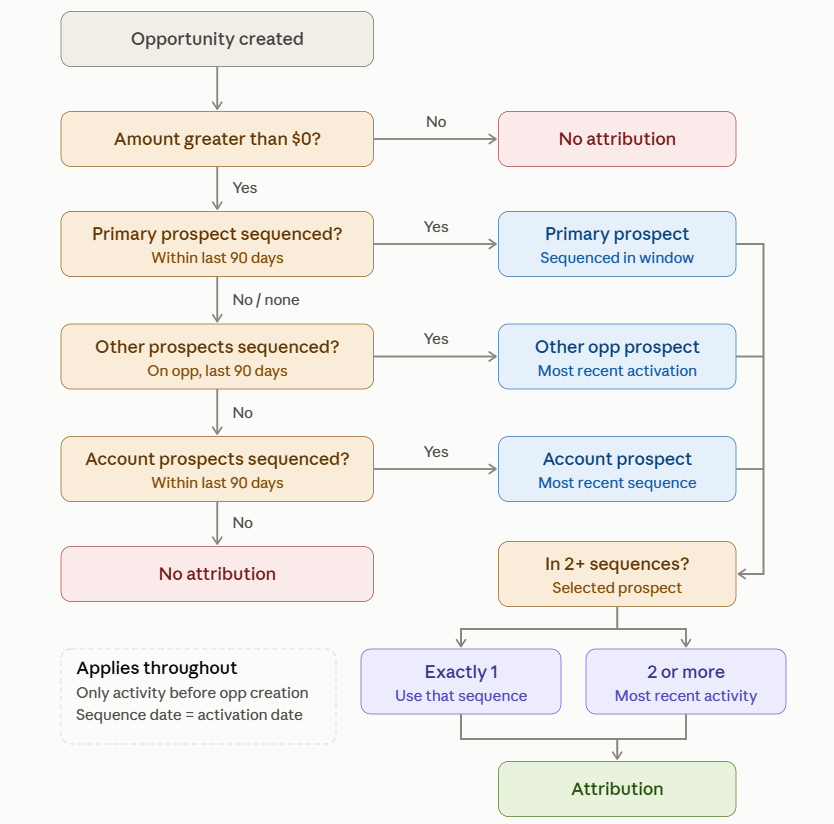
The numbered steps after it describe the same checks in text.
Outreach applies these checks in order, and stops when a check finds a match:
- Check the opportunity Amount. If the amount is $0 or less, Outreach does not attribute the opportunity to a sequence.
- Check the primary prospect on the opportunity. If the primary prospect was put in a sequence in the 90 days before the opportunity was created, Outreach selects that prospect.
- If the primary prospect was not sequenced in that window, or the opportunity has no primary prospect, check the other prospects on the opportunity. If any were put in a sequence in that window, Outreach selects the prospect with the most recent sequence activation.
- If no prospect on the opportunity was sequenced in that window, check the other prospects on the opportunity's account. If any were put in a sequence in that window, Outreach selects the prospect in the most recent sequence.
- If no prospect on the opportunity or the account was sequenced in that window, Outreach does not attribute the opportunity to a sequence.
When the Selected Prospect Is in More Than One Sequence
- If the selected prospect is in exactly one sequence, Outreach attributes the opportunity to that sequence.
- If the selected prospect is in two or more sequences, Outreach attributes the opportunity to the sequence with the most recent activity.
Rules That Apply to Every Check
- Only activity before the opportunity creation date counts. Sequence activity that starts after the opportunity is created does not change attribution.
- Sequence timing is based on the sequence activation date.
- When you filter by Users or Teams, the report shows opportunities owned by those users or teams, based on the owner field mapped on the Opportunity object in the CRM integration. The filter does not use the user who created the opportunity.
Example: Attribution Through an Account Prospect
An opportunity is created with an Amount of $50,000. The only contact on the opportunity, who is also the primary prospect, was never added to a sequence. Another prospect on the same account, who is not on the opportunity, was added to Sequence A 40 days before the opportunity was created.
Outreach checks the primary prospect and finds no sequence in the 90-day window. There are no other prospects on the opportunity to check, so Outreach checks the account prospects and selects the prospect who was added to Sequence A. The opportunity appears under Created Opportunities for Sequence A, even though the contact on the opportunity was never enrolled in it.
This is expected behavior. To confirm the attribution, select the opportunity in the drill-in and review the prospects on the opportunity's account.
FAQ
Why is an opportunity attributed to a sequence that its contact was never in?
Outreach checks account prospects after it checks the prospects on the opportunity. If a different prospect on the same account was sequenced in the 90 days before the opportunity was created, the opportunity is attributed to that prospect's sequence.
Why is an opportunity not attributed to any sequence?
Common reasons include:
- The opportunity Amount is $0 or less.
- No prospect on the opportunity or the account was sequenced in the 90 days before the opportunity was created.
- The sequence activity happened after the opportunity was created.
- The revenue attribution eligibility requirements are not met.
Why does a meeting attribute to a different sequence than the opportunity?
Meeting attribution and opportunity attribution use separate logic. Meeting attribution is based on sequence activity in the 30 days before the meeting is booked. Opportunity attribution is based on sequence activity in the 90 days before the opportunity is created.
Additional Information
Was this article helpful?
That’s Great!
Thank you for your feedback
Sorry! We couldn't be helpful
Thank you for your feedback
Feedback sent
We appreciate your effort and will try to fix the article